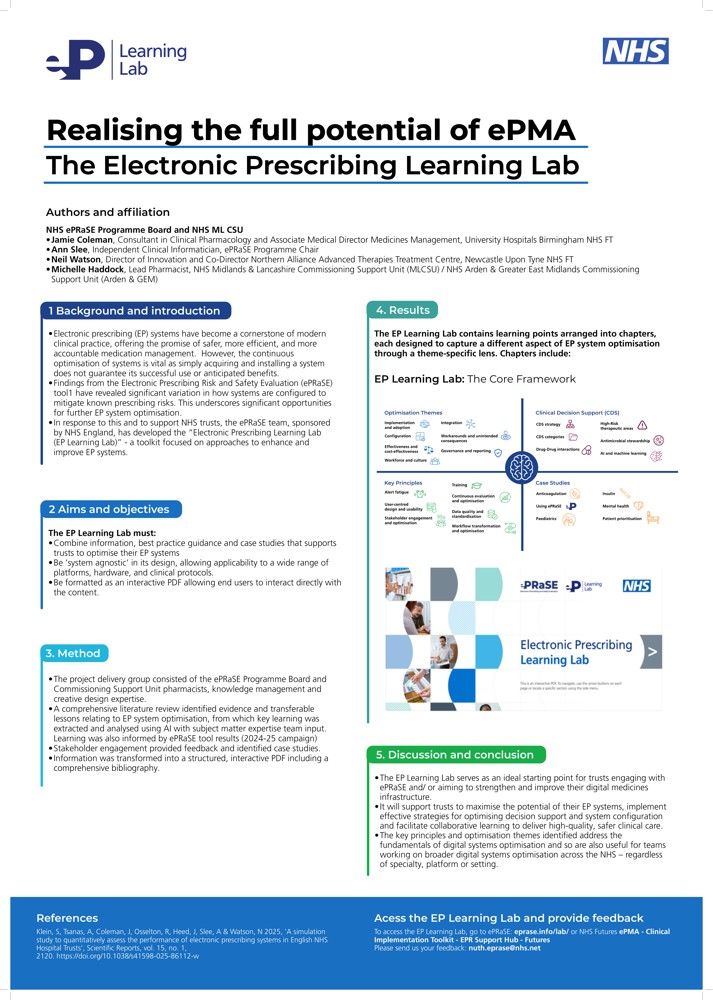
Unlocking the full potential of electronic prescribing: The EP Learning Lab

Clinical Pharmacy Congress highlights
Electronic prescribing (EP) systems are now firmly embedded in modern clinical practice, promising safer, more efficient and more accountable medication management. Yet implementation alone is not enough. Research using the Electronic Prescribing Risk and Safety Evaluation (ePRaSE) tool has revealed considerable variation across NHS trusts in how EP systems are configured to mitigate known prescribing risks — highlighting significant room for improvement.
In response, the ePRaSE team, sponsored by NHS England, has developed the Electronic Prescribing Learning Lab (EP Learning Lab): a practical, evidence-based toolkit designed to help trusts optimise their EP systems and realise their full clinical benefit.
Poster presenter, Michelle Haddock commented:
“The Lab is really useful if people have not understood the concept of system optimisation. It’s an evidence-based approach, it’s not a step-by-step guide”.
What is the EP Learning Lab?
Developed by the ePRaSE Programme Board and NHS Midlands & Lancashire CSU — with contributions from clinical pharmacology, informatics and innovation — the EP Learning Lab is an interactive PDF resource structured around a core framework of optimisation themes. These include system configuration, integration, clinical decision support (CDS), governance and reporting, workforce and culture, and drug–drug interactions, among others.
The resource draws on a comprehensive literature review, analysis of ePRaSE 2024–25 campaign data, AI-assisted knowledge synthesis, and real-world case studies covering areas such as anticoagulation, insulin prescribing, paediatrics and mental health.
Crucially, the EP Learning Lab is system-agnostic — designed to be applicable across different EP platforms, hardware environments and clinical protocols, making it relevant to a wide range of NHS settings.
Why it matters
For health professionals involved in medicines management, digital transformation or patient safety, the EP Learning Lab offers a structured starting point for identifying and addressing gaps in EP system performance. It supports trusts to strengthen clinical decision support tools, reduce alert fatigue, improve data quality and drive workflow optimisation.
The toolkit’s principles extend beyond EP systems, offering value to any team engaged in broader digital systems improvement across the NHS.
Access the EP Learning Lab at www.eprase.info/lab/ or via NHS Futures.
Photo: Michelle Haddock Lead Pharmacist, NHS Midlands & Lancashire Commissioning Support Unit (MLCSU) / NHS Arden & Greater East Midlands Commissioning Support Unit (Arden & GEM)