PRUK-supported research projects
Pharmacy Research Showcase highlights
Three routes into research
At the Pharmacy Research Showcase, three people whose research is supported by Pharmacy Research UK (PRUK) described their own journeys. A renal pharmacist, a mental health pharmacist and a pharmacy technician each showed how funding, protected time and good support can help turn a clinical question into a viable research project.
Tackling the medication burden in kidney disease
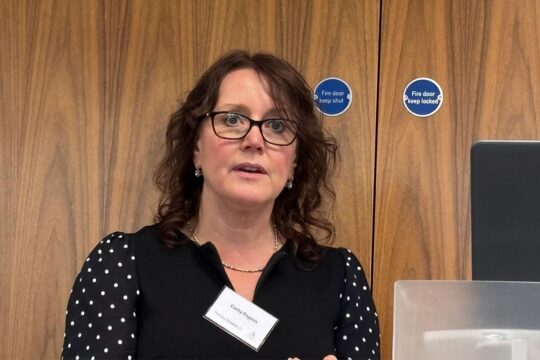
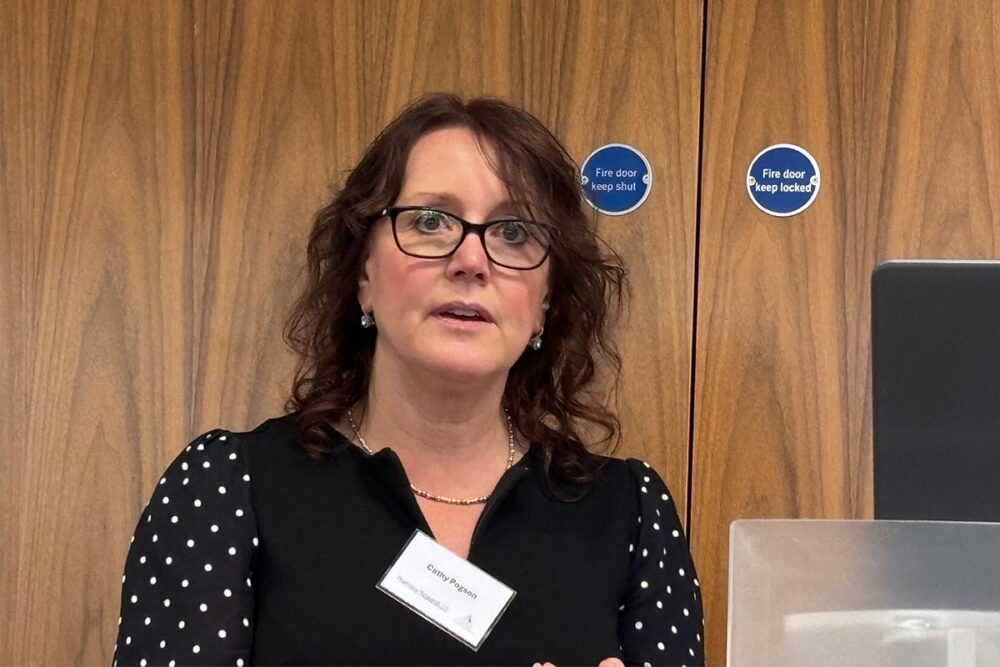
Cathy Pogson, a renal pharmacist in Portsmouth, holds a PhD fellowship jointly funded by Kidney Research UK and PRUK. Her focus is the very high medicines burden carried by people under the care of nephrologists. Many take 10 to 14 regular medicines, see several prescribers and often face low health literacy and social deprivation. Patients on dialysis tolerate more medicines than most, she said, but beyond about 14 a day the burden becomes too much and quality of life falls.
Structured medication reviews in primary care are a valuable service, but they may not suit this group. Renal patients spend a lot of time in hospital, and those on dialysis already see their specialist nephrology team three times a week. Do they really want to see a non-specialist to have their medicines reviewed? she asked.
Ms Pogson’s path was not straight. An NIHR internship of one day a week for six months refreshed her research skills. Her first PhD application was turned down. She was not ready, she admitted, and the extra time made her research stronger. A pre-doctoral fellowship followed, during which she published a scoping review in the British Journal of Clinical Pharmacology, completed research methods modules and formed a patient and carer group.
That group transformed her understanding of the patients’ experiences. Patients’ comments included: “When I go to the GP, everything flags red. This is scary. I don’t know what anything is for”, and “Non-kidney specialists choose the wrong medicines for me. I only trust kidney people to offer me the correct medicines”. Another said, “My medicines come from many suppliers. This affects me doing things. I must wait in all day for them to arrive”. Moreover, the NHS App does not list the complex medicines supplied by hospitals, such as transplant drugs, so lists are only partial at best.
Ms Pogson’s PhD now uses the person-based approach, a framework built around users’ needs. With Health Research Authority (HRA) approval in place, she is setting up studies at Portsmouth, King’s and University College London (UCL). This mix gives her access to both coastal deprivation and wider ethnic diversity, she explained. Co-design workshops will follow, with the aim of producing a new medicines optimisation intervention.
Stopping antidepressants safely
Sarah Jones, a former specialist mental health pharmacist who now teaches at The University of Bath, holds a PRUK PhD studentship. She has had a longstanding interest in deprescribing of antidepressants. In some areas up to 20% of adults take an antidepressant, but most research on withdrawal effects does not reflect primary care, where most prescribing happens. Patients told her they felt caught in the middle of a heated academic debate and simply wanted better information. Her research project is designed to look at how antidepressant deprescribing is managed in primary care and how patients who want to stop their treatment can best be supported.
A prospective, mixed methods study will follow patients for six months from the start of a reduction, using questionnaires at one, three and six months and interviews with a subgroup. It will also interview pharmacists and nurse prescribers, whose views are often missing.
She was open about the challenges. A stream of new papers has meant constant rethinking, and a withdrawal rating scale that “everybody uses” turned out to exist in many versions. Studying half-time has also left little space for deep thinking.
A technician’s route to a master’s
Debbie Sutton, a pharmacy technician, built her trust’s clinical trials pharmacy team from scratch and later moved into research development. A PRUK bursary now funds her master’s degree and buys protected time. Her dissertation will compare medication histories taken to check clinical trial eligibility with those taken for non-research patients, in terms of pharmacy oversight and training requirements.
Her biggest hurdle was access. Technicians usually qualify through vocational routes, and few universities accept equivalent experience or explain what it means. She now plans to study the problem. Her tips for applicants were to read the guidance in full, pick a project you care about, talk to peers and the NIHR Research Support Service, involve your employer and Research and Development (R&D) department early, and believe in yourself.
Common threads
The three stories share some lessons. Each research question came from everyday clinical practice. Patient involvement shaped every project. Protected time, good supervision and professional networks made the work possible, and setbacks along the way often made it stronger. For anyone thinking of applying, PRUK’s funding round usually opens in November and closes in March.
Pharmacy Research Showcase
The Pharmacy Research Showcase was a one-day event organised by the NIHR-Supported Incubator for Pharmacy Professionals which brought together policy-makers and researchers to share experiences and insights. It was held on 22nd October 2026 at the Royal College of Pharmacy headquarters in London.
Image: Cathy Pogson