Making research part of routine pharmacy work
Pharmacy Research Showcase highlights
How can a trust make research a normal part of pharmacy work rather than an optional extra? Jatinder Harchowal MBE, Chief Pharmacist and Divisional Clinical Director at University College London Hospitals (UCLH), answered that question at the Pharmacy Research Showcase with lessons from almost ten years of practice.
Research has run through his own career, from his first published paper as a renal pharmacist in the 1990s to acting as principal investigator on a large study. At UCLH, one of the country’s largest research organisations, every member of staff is expected to take part in research in some form. That sounds easy, he admitted, but it is not. Leaders have to set the tone and then make the space for staff to do it.
A dedicated centre and aligned strategy
Central to UCLH’s approach is CMORE, the Centre for Medicines Optimisation Research and Education. It was set up in 2017 by its director, Dr Yogini Jani, as a partnership between UCLH and the UCL School of Pharmacy. Its aim is to make research training accessible to all pharmacy staff, with mentoring, supervision and help with grant bids at every stage.
What began as a local collaboration has become a “well-worked system”. Over almost a decade it has supported more than 17 fellowships, more than 19 awards and prizes, over 200 publications and more than 110 national and international conference presentations.
Mr Harchowal stressed the value of aligned strategies. One of the six pillars of the pharmacy and medicines optimisation strategy is about using evaluation, research and advanced analytics to improve care. The trust’s new five-year strategy also includes a pillar on fully integrating research across all healthcare professions. When aims line up like this, he said, it is clear to everyone that research matters.
Three routes into research
He gave three examples to illustrate how research has been built into the day-to-day working of the pharmacy service. First, UCLH ran the first NIHR undergraduate internship at the trust. A UCL pharmacy student and a King’s College London nursing student studied the information given to thoracic surgery patients discharged on opioids. They learned to frame questions, carry out research and publish, and went on to present at conferences.
Second, the pharmacist-led hypertension clinic built evaluation into an existing service from the start. Six pharmacists now review patients and evaluate the service at the same time, showing that research does not always need extra protected time.
Third, and most successful, was the research-active pharmacy technician programme. When the trust funded 16 pre-registration technician posts, the team designed the roles from the outset to include structured, publishable research. The technicians now present nationally and internationally and have won NIHR funding. They have probably set the bar for many pharmacists, he said.
Lessons for other trusts
Mr Harchowal’s advice was to give staff permission and visible support from the top, and then to make the time. Building research into objectives and providing training and tools helps make it part of the daily job.
He urged teams to celebrate success. UCLH’s Festival of Excellence, now in its fourth year, accepted 96 pieces of multidisciplinary work this year, he said. He also encouraged visits to other organisations, crediting colleagues in Northumbria for shaping UCLH’s approach.
He ended with a warning. Other professions are “pushing the doors as much as we are“, moving into research quickly, and if pharmacy does not step up, others will fill that space.
Pharmacy Research Showcase
The Pharmacy Research Showcase was a one-day event organised by the NIHR-Supported Incubator for Pharmacy Professionals which brought together policy-makers and researchers to share experiences and insights. It was held on 22nd October 2026 at the Royal College of Pharmacy headquarters in London.
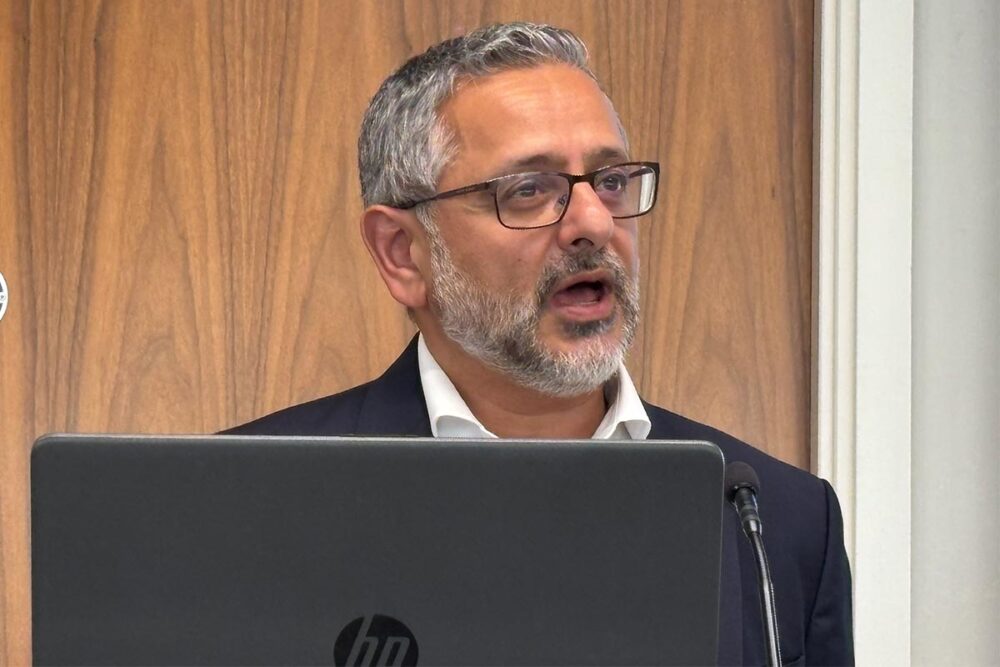
Image: Jatinder Harchowal