Daridorexant – transforming insomnia management
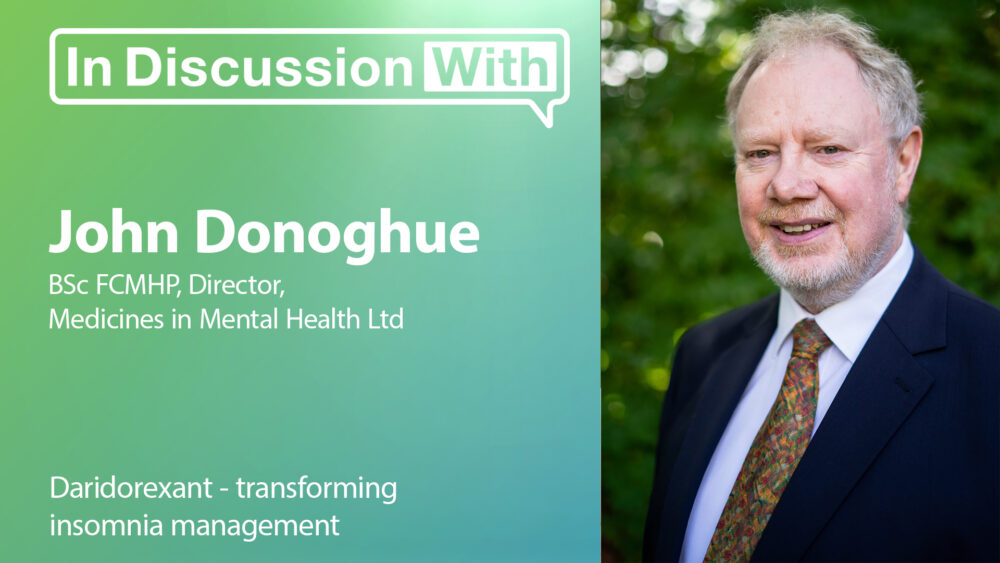
Insomnia is frequently underestimated by both the general public and healthcare professionals, often viewed as being part of the “natural order of things” or a transient response to stress. However, as John Donoghue (Director, Medicines in Mental Health Ltd) emphasises, true insomnia is a serious condition with profound implications for physical health, mental well-being and mortality. In this interview he explains the impact of insomnia and describes the evidence-based strategies to manage insomnia effectively. These include the use of daridorexant, a dual orexin receptor antagonist (DORA).
Defining the clinical burden
Insomnia is more than a few sleepless nights. Diagnosis requires three components: difficulty falling asleep, difficulty staying asleep, and significant next-day consequences. Chronic insomnia is defined by these symptoms occurring at least three times a week for more than three months.
The epidemiological data is sobering. Chronic insomnia affects 5% to 10% of the adult population and is strongly associated with chronic physical illnesses involving pain or respiratory distress, as well as psychiatric disorders such as major depression.
The consequences of sleeping less than five or six hours a night are significant:
- The risk of type 2 diabetes trebles
- The risk of hypertension increases fivefold
- The risk of vascular dementia and impaired cognitive functioning more than doubles.
Furthermore, even a small reduction in sleep (less than six hours compared to seven to nine) is associated with a 13% increase in mortality risk due to accidents, stroke, cardiovascular disease and cancer.
In mental health, insomnia acts as a “multiplier” of poor outcomes. A landmark study using big data found that in patients with major depression, those with comorbid insomnia had more GP appointments, higher medication consumption, more psychiatric admissions, and increased rates of attempted suicide.
The limitations of traditional pharmacotherapy
Both benzodiazepines and the “Z-drugs” (e.g. zopiclone) are used for the short-term management of insomnia. Both classes of drug promote the actions of the inhibitory neurotransmitter gamma amino butyric acid (GABA) in the central nervous system. In effect, they “dial up” the effects of GABA. Benzodiazepines are non-selective; they affect pathways relating to sleep and also those relating to anxiety and memory. “In addition to inducing sleep, they’re anxiolytic but they also have an amnesic effect which is quite common with benzodiazepines, particularly [for] short-term memory” explains Mr Donoghue. The Z-drugs lack the anxiolytic effects and generally have shorter half-lives than benzodiazepines, making them less likely to have next day hangover effects.
A NICE appraisal concluded that there was no compelling evidence of a clinically useful advantage with Z drugs and recommended that short-acting benzodiazepines should continue to be the treatments of choice. Mr Donoghue noted that the commonly-used (short-acting) temazepam has a half life of 10-20 hours, meaning that after a 20mg night-time dose,10 mgs could still be in the body the next morning. “And here’s one of the things that pharmacists must advise patients – not ‘be careful when you’re driving’, but simply ‘do not drive’. Do not operate dangerous machinery of any kind, because even the short acting benzodiazepines have significant hangover effects” says Mr Donoghue.
Antihistamines (e.g. diphenhydramine), antidepressants and antipsychotics are also sometimes used for insomnia. Although over-the-counter antihistamines are often recommended for insomnia but they are commonly associated with side effects such as ataxia, blurred vision, constipation and dizziness. “So, diphenhydramine and drugs like promethazine are not the benign drugs that we think they are, and they do need to be used cautiously, and patients should be warned about particularly the danger involved with driving after they’ve been taking them”, he says. Antidepressants and antipsychotics should be avoided as hypnotics, he adds.
Orexin and chronic insomnia
The discovery of orexin in the late 1990s changed the understanding of the sleep-wake cycle. Orexin is an excitatory neurotransmitter that acts as the brain’s “wake signal,” released in response to daylight to kickstart alertness.
Current thinking suggests that chronic insomnia is not necessarily a lack of “sleep pressure” but rather a disorder of orexin overactivity. Essentially, the wake signal is being released inappropriately during the night. This explains why simple sleep hygiene measures often fail in chronic cases; sleep hygiene measures cannot suppress the inappropriate release of orexin.
Daridorexant: A dual orexin receptor antagonist (DORA)
Daridorexant represents a new class of treatment approved by NICE for chronic insomnia in adults. Unlike traditional hypnotics that induce sleep by “closing down” the brain, Daridorexant is a DORA that blocks the wake signal from reaching excitatory pathways. It suppresses both the wake signal (Orexin 2 receptor) and the motivation/reward signal (Orexin 1 receptor), allowing sleep to occur naturally while maintaining normal background brain activity.
Clinical evidence and safety
Two large randomised controlled trials published in The Lancet Neurology highlight several key findings for clinicians1:
- Efficacy: At the 50mg dose, patients gained approximately one hour of extra sleep per night after three months, falling asleep 30 minutes faster and waking up for 30 minutes less.
- Daytime alertness: Critically, daridorexant showed a significant improvement in daytime alertness, with no “hangover” effects observed.
- Long-term profile: In a 12-month extension study, there was no evidence of loss of effect over time and, remarkably, no withdrawal symptoms upon discontinuation.
- Tolerability: The side effect profile is “remarkably benign,” with only fatigue occurring more frequently than placebo (affecting only 1 in 25 patients).
Responding to symptoms of insomnia
NICE recommends daridorexant as a second-line treatment following cognitive behavioural therapy for insomnia (CBTI). However, if CBTI is unavailable or the patient refuses it, daridorexant can be considered first-line.2
When patients seek help for insomnia in primary care Mr Donoghue suggests five key questions should be asked:
- What are the sleep problems (getting to/staying asleep)?
- Are there external factors (noise, shift work)?
- How long has it been going on (the 3-month threshold)?
- How often does it occur (the 3-times-a-week threshold)?
- How do you feel the next day?
Patients who meet the criteria for chronic insomnia should either be referred to their GP or a prescribing pharmacist, who may consider prescribing daridorexant.
Regarding the cost – a common barrier to prescribing – Mr Donoghue points out that at £42 per month, the treatment costs less than half a cup of coffee per day. Given the serious consequences of chronic insomnia for people’s emotional, mental and physical well-being, this makes it a highly cost-effective intervention.
About John Donoghue
John Donoghue is the Director of Medicines in Mental Health Ltd. His work involves:
- The provision of continuing education related to the treatment of severe mental illness. His key interest is schizophrenia, but he also covers major depression and bipolar disorder. He provides medical education to psychiatrists, pharmacists, mental health nurses, psychologists and social workers.
- Pharmaco-epidemiology research. He was an early adopter of big data and has been involved in landmark studies using big data to follow outcomes in major depression.
- Consultancy He provides consultancy services, mostly to the pharmaceutical industry but also occasionally to the National Health Service.
Mr Donoghue is also a published novelist. His debut novel, The Death’s Head Chess Club was published in 2015. His new novel, Not Alive, Not Dead, was published in 2025.
References
- Mignot E, Mayleben D, Fietze I, Leger D, Zammit G, Bassetti CLA, Pain S, Kinter DS, Roth T; investigators. Safety and efficacy of daridorexant in patients with insomnia disorder: results from two multicentre, randomised, double-blind, placebo-controlled, phase 3 trials. Lancet Neurol. 2022 Feb;21(2):125-139. doi: 10.1016/S1474-4422(21)00436-1.
- NICE Technology appraisal guidance (TA 922) Daridorexant for treating long-term insomnia. October 2023