As use of AI scribes spreads, researchers propose a framework for preparing medical trainees

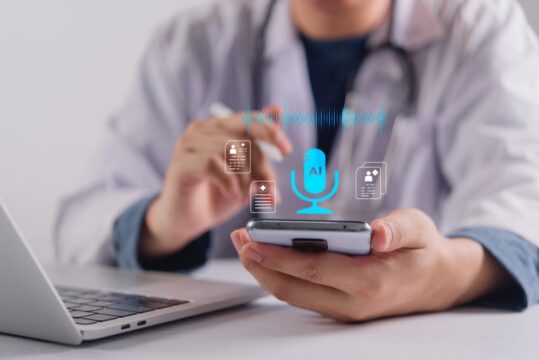
Ambient AI scribes, which passively capture clinical encounters and draft notes, are among the most rapidly adopted artificial intelligence (AI) applications in health care. In one integrated health care system, they documented more than 2.5 million clinical encounters in a single year. Early evidence suggests real benefits from these tools. Yet the outcomes measured thus far—including documentation time, cognitive workload, and clinician burnout—address the value of the tools for workforce sustainability, not medical education. Their use has spread through clinical settings faster than curricula can adapt, leaving medical schools unprepared.
In a new article in npj Digital Medicine, researchers at Carnegie Mellon University and the University of Pittsburgh School of Medicine propose a framework that defines the review of AI-generated clinical documentation as a teachable competency and describe how it can be taught through simulation.
“Physicians are shifting from writing clinical notes to editing AI-generated ones, and that changes what trainees need to learn, a challenge we’re facing across higher education,” says Holly Wiberg, assistant professor of public policy and operations research at Carnegie Mellon’s Heinz College, who coauthored the article. “Ambient AI can ease documentation burden and has potential to improve quality, but only if clinicians use it critically: evaluating its output and recognizing its failure modes. Our goal is to give trainees a structured way to build those skills so they enter this new work environment well prepared.”
The editorial skills needed to review AI documentation competently are specific and teachable, the authors say, not innate extensions of clinical practice. And nothing in current medical schools’ curricula targets these skills directly.
Yash Raka, an MD candidate at the University of Pittsburgh School of Medicine and a co-author of the article, explains: “As a medical student, I’m part of the first generation likely to edit AI-generated notes as often as we write our own—and medical education is still catching up to what that shift requires. Reviewing AI documentation may seem like a small editorial task, but it carries the synthesis, prioritization, and judgment that manually writing notes independently has long developed in trainees. This framework is a way to start building those skills intentionally.”
The article identifies four domains involved with reviewing AI-generated clinical documentation:
- Detecting errors and omissions: Can trainees identify factual errors, omissions, hallucinations (when systems present false, misleading, or fabricated information with absolute certainty), and misattributions in AI-generated clinical notes?
- Judging whether the notes reflect the clinical reasoning of the medical visit: Can trainees determine whether an AI-generated note reflects the clinical reasons behind the encounter, not merely its facts?
- Generating notes independently: Can trainees produce clinically sound notes on their own when AI is unavailable or inappropriate, or when a patient does not consent to the use of AI?
- Calibrating trust across contexts: Do trainees appropriately adjust their reliance on AI output across clinical contexts?
In each domain, the authors propose learning objectives, simulation exercises, and ways to assess competency, as well as timelines for teaching these skills.
“Simulation lets trainees practice catching an AI’s mistakes in a low stakes way where it won’t affect patient outcomes,” says Reed Van Deusen, associate professor in general internal medicine and pediatrics at the University of Pittsburgh School of Medicine, another co-author. “When we build errors into simulated encounters, we can see exactly what a learner misses and give targeted feedback, which is hard to do in clinical training environment.”
The authors note that this proposed framework is preliminary and call for empirical testing to refine it. They see the framework as a starting point and envision developing curricular components aligned with their proposed exercises, with the hope that it could eventually inform how medical schools prepare trainees for AI-assisted practice.