Smarter, faster, safer: automating discharge summaries with Anathem AI
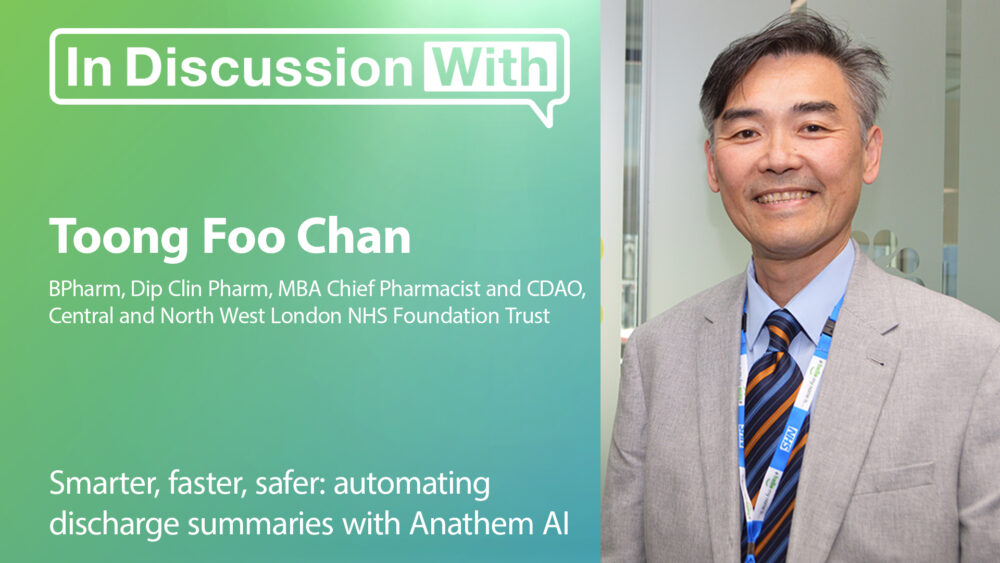
Discharge summaries are among the most important documents in healthcare, yet they are frequently late, inconsistent, and incomplete. In this interview, Toong Foo Chan, Chief Pharmacist and Controlled Drug Accountable Officer at Central and North West London NHS Foundation Trust, describes a quality improvement project that combined redesigned workflows with artificial intelligence (AI) to transform the way discharge summaries are prepared and sent to GPs, community teams, and patients.
Why discharge summaries matter
A discharge summary is the primary method of communicating what happened during a hospital stay to GPs, community teams, community pharmacists, and sometimes patients’ carers. When this transfer of information is delayed or incomplete, the consequences can be serious: GPs may fail to follow up appropriately, or may unknowingly re-prescribe medication that caused harm in the first place. Patients themselves are often unclear about their own medication changes, increasing the risk of errors after discharge. The project’s goal, says Mr Chan, was to “improve both the quality and the timeliness of discharge information while reducing the administrative burden on clinicians.”
A process under strain
Before the redesign, the discharge process was slow and highly variable. Clinicians often had to review hundreds of pages of notes before compiling a summary — a particular challenge on mental health wards, where admissions can range from 30 to 120 days. Completion rates within 24 hours of discharge varied considerably between wards, from around 70% down to just 30%. Ownership of the task was also unclear, with doctors and pharmacists sometimes each assuming the other was responsible, while junior doctors juggled competing priorities. The result was delay, and community clinicians left without timely information on diagnosis, treatment, and medication changes.
Redesigning the pathway before adding AI
Recognising that the problem could not be solved by one professional group alone, the trust convened a multidisciplinary co-production group, chaired by a consultant psychiatrist. The team used performance data and direct feedback from GPs to clarify responsibilities and standardise workflows before considering any technology. This groundwork alone raised the overall proportion of discharge summaries reaching GPs within 24 hours to around 60% — but progress then plateaued.
Introducing AI
The trust had already been using an AI platform, Anathem, for about two years to support ambient voice transcription of outpatient consultations. Extending this technology to discharge summaries was, “a natural progression” says Mr Chan. The AI reviews up to 300 pages of clinical notes and drafts the two-part discharge document: a clinical summary and a medication summary, including the reason for admission, diagnosis, interventions, medication changes and reasons for stopping drugs, and follow-up requirements. Feedback from GPs showed they rarely read beyond two pages, so the AI-generated document was deliberately condensed to that length.
The impact on efficiency has been substantial. Producing a discharge summary manually took a junior doctor 45 minutes to an hour; with AI support, this has fallen to around 20 minutes. Timeliness has also improved sharply, with 24-hour completion rates rising from 60% to around 90%.
Safeguards and accountability
Crucially, the AI does not send documents automatically. The resident doctor must review, edit, and formally sign off the summary using a smart card before it is transmitted electronically to the GP, retaining full professional accountability. This reflects lessons learned from early problems, including “hallucinations or confabulations”; in one case, the AI mistakenly recorded a patient’s suicidal ideation as an intent toward strangulation. Such incidents reinforced the trust’s view that AI can support clinicians but cannot replace their judgement.
Access to the tool is similarly staged. Foundation-level doctors (F1 and F2) are excluded. Specialty Trainee (ST) level doctors must first demonstrate they can produce a discharge summary manually before AI access is granted — an approach Mr Chan compares to a pilot needing to be able to fly a plane manually before using autopilot.
What’s next
Having piloted the approach on three wards, the trust now plans to scale it across the wider hospital and into community services, while continuing to gather feedback from clinicians, GPs, and patients. Mr Chan believes the model is transferable across the NHS, since safe information transfer between care settings is a universal challenge, even if local workflows differ.
Looking ahead, he is clear that AI will not replace healthcare professionals. “The future is not about replacing healthcare professionals with machines,” he says. “It is about augmenting them… The combination of human judgment, compassion and professional accountability, supported by well-governed technology, will deliver the safest care to the patient.”
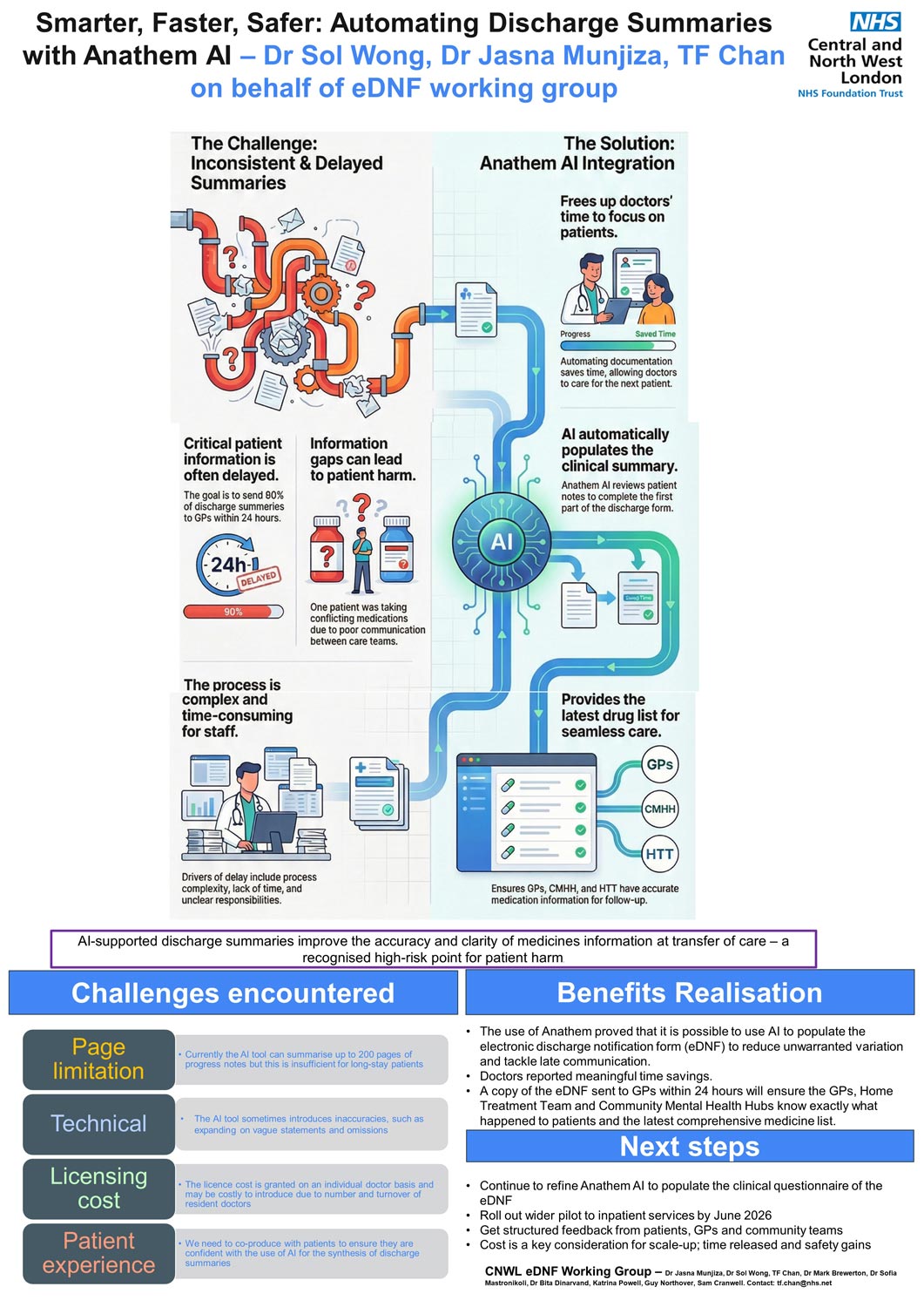
Poster presented at the Clinical Pharmacy Congress. London 8-9th May 2026