Finerenone meets primary endpoint in pivotal Phase III FIND-CKD study in patients with non-diabetic chronic kidney disease – Bayer
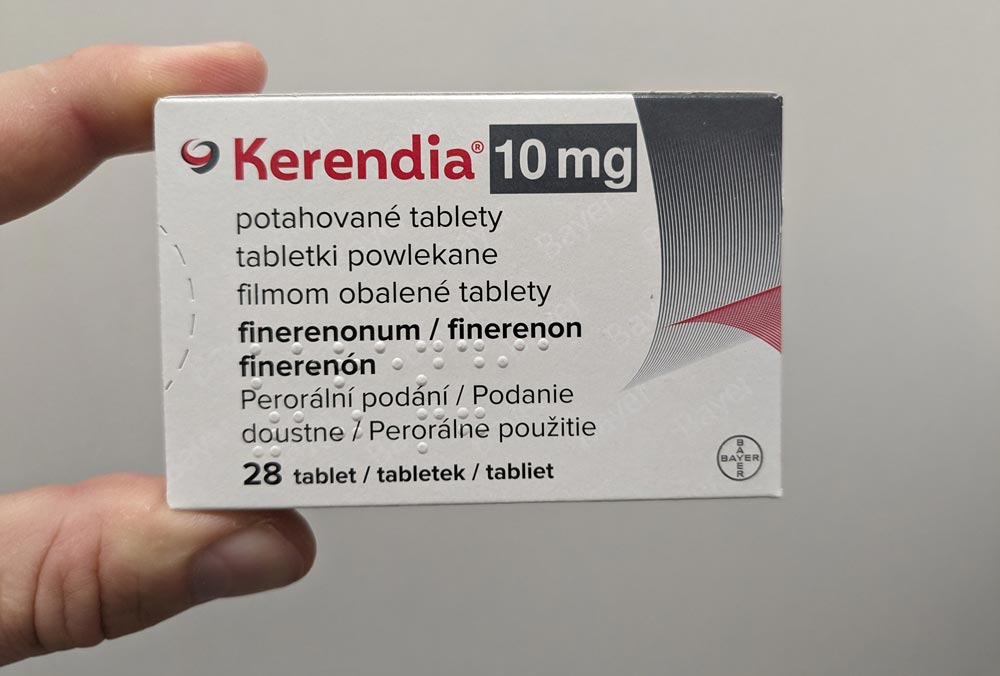
The Phase III study FIND-CKD, evaluating the efficacy and safety of finerenone (Kerendia) versus placebo when added to standard of care in adult patients with non-diabetic chronic kidney disease (CKD), has met its primary endpoint. The results showed that finerenone reduced kidney function decline by achieving a statistically significant and clinically meaningful improvement versus placebo in addition to standard of care in the estimated glomerular filtration rate (eGFR) slope, defined as the mean annual rate of change in eGFR from baseline to Month 32. The eGFR slope is a validated surrogate endpoint for clinical kidney outcomes and is used as a predictive metric for the risk of kidney failure. Finerenone was well-tolerated in the FIND-CKD study, which is consistent with the well-established safety profile of finerenone. The clinical data from FIND-CKD will be presented at an upcoming scientific conference, and Bayer plans to submit the data to health authorities to extend the indication of Kerendia to this patient population.
Approximately 850 million people worldwide are living with chronic kidney disease (CKD) and more than half of them have non-diabetic CKD. Non-diabetic CKD can have a range of etiologies, of which the most common include hypertension and glomerulonephritis (including immunoglobulin A nephropathy (IgAN)). Chronic kidney disease linked to hypertension is the second most common cause of kidney failure. Worldwide, more than 3.5 million people with kidney failure are treated with dialysis, which is linked to a 5-year survival rate of about 40% after treatment initiation. In addition, patients with advanced non-diabetic CKD face a significantly increased risk for a fatal cardiovascular event, about 2.6 times higher than that of the general population without CKD, which increases further as kidney function declines. Despite the high prevalence and high morbidity and mortality rate, non-diabetic CKD etiologies remain underrepresented in international clinical practice guidelines.
The Phase III FIND-CKD study (FInerenone, in addition to standard of care, on the progression of kidney disease in patients with Non-Diabetic Chronic Kidney Disease, NCT05047263) investigated finerenone compared to placebo in addition to standard of care in more than 1,500 patients with non-diabetic chronic kidney disease etiologies, including hypertension and chronic glomerulonephritis. Patients were randomized to receive either finerenone 10mg or 20mg or placebo on top of maximum tolerated labeled doses of a renin-angiotensin system (RAS)-blocking therapy such as an angiotensin-converting enzyme (ACE) inhibitor or an angiotensin II receptor blocker (ARB). The primary endpoint was the mean annual rate of change in eGFR from baseline to Month 32. Secondary endpoints included a combined cardio-kidney endpoint, which was a composite of kidney failure, sustained ≥57% eGFR decrease, hospitalization for heart failure or cardiovascular death. The safety endpoints were the occurrence of treatment-emergent adverse events (AEs), treatment-emergent serious AEs, and hyperkalemia AEs.
“Patients with non-diabetic chronic kidney disease experience a progressive loss of kidney function and are at high risk of kidney failure and cardiovascular disease. New treatments that can reduce kidney disease progression are needed to help improve the prognosis of these patients, who have a substantial risk for cardiovascular events and kidney failure which can necessitate dialysis,” said Dr. Hiddo L. Heerspink, Professor of Clinical Trials and Personalized Medicine, clinical trialist at the Department of Clinical Pharmacy and Pharmacology at the University Medical Center Groningen, Netherlands, and Co-Chairman of the study’s Executive Committee. “The FIND-CKD results are encouraging because they show the benefits of finerenone in preserving kidney function in a dedicated study across several etiologies of non-diabetic chronic kidney disease.”
“The positive results of the Phase III FIND-CKD study represent an important advancement in the area of non-diabetic chronic kidney disease, regardless of the underlying cause,” said Dr. Christian Rommel, Global Head of Research and Development at Bayer’s Pharmaceuticals Division. “Combined with the overall evidence from the THUNDERBALL chronic kidney disease clinical trial program including the pivotal studies FIDELIO-DKD, FIGARO-DKD, and FINE-ONE, these results further strengthen the evidence on the consistent benefits of finerenone in the treatment of patients with chronic kidney disease.”