Whooping cough vaccination during pregnancy boosts newborn immunity
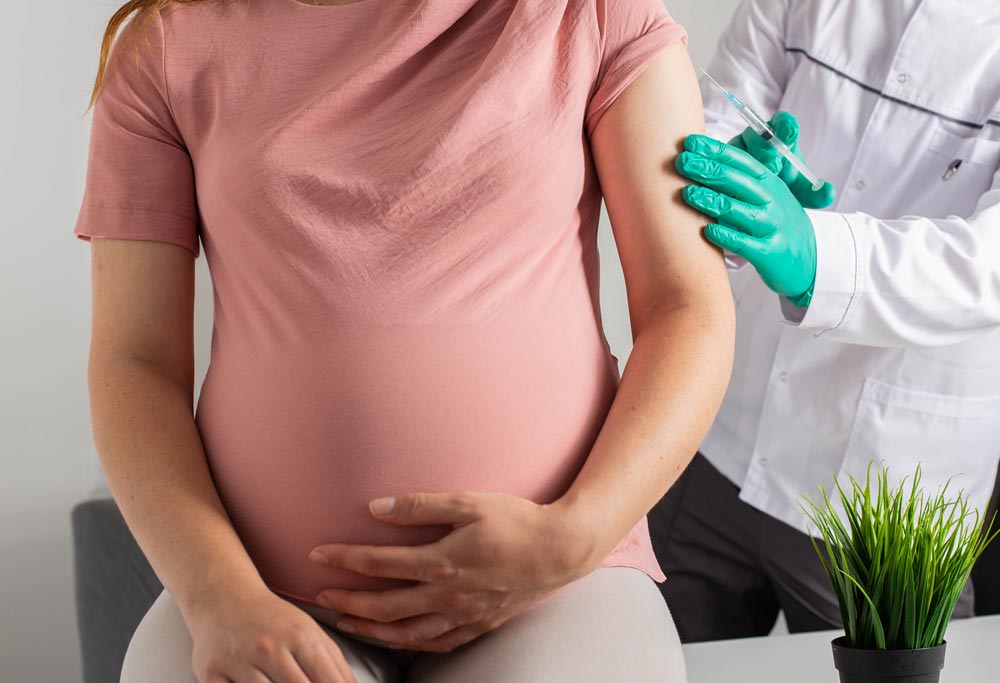
Researchers have shown for the first time that maternal antibodies are found not only in the blood of newborns, but also in the nasal mucosa. The international study, led by Charité – Universitätsmedizin Berlin and Radboud University, was published in The Lancet Microbe, and strengthens the case for maternal vaccination during pregnancy.
Whooping cough can be fatal in newborns. The disease is on the rise in Germany, with 122 cases per 100,000 inhabitants, mostly in babies aged less than one year. Protection against this highly contagious disease in the first months of life is provided by vaccinating expectant mothers against the bacterium, Bordetella pertussis.
Babies receive the first of three vaccine doses from the age of two months. In Germany and most European countries, pregnant women are advised to be vaccinated against whooping cough to bridge the gap until infants develop immunity through vaccination. Expectant mothers pass on their protective antibodies to their unborn child via the placenta. This represents a safe and effective method of indirect immunisation that is effective from birth.
A research team led by Prof. Beate Kampmann, Director of the Institute of International Health at Charité and Scientific Director of the Charité Center for Global Health, has now proven that the antibodies transmitted by the mother are not only present in the blood but also in the nasal mucosa of newborns – which is precisely where the pathogens enter the body.
‘We knew that maternal antibodies are passed on by way of the placenta. We were surprised, however, to find that we could also detect them in the nasal mucosa of newborns – in a manner that is gentle on the children. This underlines the effectiveness of indirect vaccination,’ as Beate Kampmann states.
The international study vaccinated 343 pregnant women in Gambia, West Africa, with either a whooping cough or tetanus vaccine. Maternal antibodies against whooping cough were detectable in both the blood and nasal mucosa of infants whose mothers had received the appropriate vaccination.
Researchers at the London School of Hygiene and Tropical Medicine continued to examine blood and nasal secretions from around 160 newborns before and after their routine pertussis vaccination with different types of vaccine.
The study showed that babies who had received a whole-cell pertussis vaccine at 8, 12, and 16 weeks of age developed a stronger immune response on average than those who had received an acellular vaccine.
‘A whole-cell vaccine contains the complete but inactivated pertussis bacterium, while an acellular vaccine contains only a few purified components of the bacterium,’ Beate Kampmann explains. ‘Acellular vaccines generally cause fewer side effects, while usually providing shorter-lasting protection. Our results suggest that the whole-cell pertussis vaccine also provides longer-lasting protection.’
The acellular vaccine has been used in Europe since 2005, while most low- and middle-income countries continue to opt for the whole-cell vaccine. ‘According to our findings, countries that use whole-cell vaccines for children should continue to do so,’ Prof Kampmann said. ‘It remains crucial, however, to vaccinate pregnant women with the acellular vaccine, regardless of which type of vaccine is subsequently given to children. Both types are capable of preventing whooping cough in newborns in more than 90 percent of all cases.’