How to relieve arthritic knee pain without drugs or surgery
Nearly a quarter of people over the age of 40 experience painful osteoarthritis, making it a leading cause of disability in adults. Osteoarthritis degrades joint-cushioning cartilage, and there is currently no way of reversing this damage: the only option is to manage pain with medication, and eventually, joint replacement.
Researchers from the University of Utah, New York University and Stanford University are now demonstrating the potential for another option: gait retraining.
By making a small adjustment to the angle of their foot while walking, participants in a year-long randomized control trial experienced pain relief equivalent to medication. Critically, those participants also showed less knee cartilage degradation over that period as compared to a group that received a placebo treatment.
Published in The Lancet Rheumatology and co-led by Scott Uhlrich of Utah’s John and Marcia Price College of Engineering, these findings come from the first placebo-controlled study to demonstrate the effectiveness of a biomechanical intervention for osteoarthritis.
“We’ve known that for people with osteoarthritis, higher loads in their knee accelerate progression, and that changing the foot angle can reduce knee load,” said Uhlrich, an assistant professor of mechanical engineering. “So the idea of a biomechanical intervention is not new, but there have not been randomized, placebo-controlled studies to show that they’re effective.”
With support from the National Institutes of Health and other federal agencies, the researchers were specifically looking at patients with mild-to-moderate osteoarthritis in the medial compartment of the knee — on the inside of the leg — which tends to bear more weight than the lateral, outside, compartment. This form of osteoarthritis is the most common, but the ideal foot angle for reducing load in the medial side of the knee differs from person to person depending on their natural gait and how it changes when they adopt the new walking pattern.
“Previous trials prescribed the same intervention to all individuals, resulting in some individuals not reducing, or even increasing, their joint loading,” Uhlrich said. “We used a personalized approach to selecting each individual’s new walking pattern, which improved how much individuals could offload their knee and likely contributed to the positive effect on pain and cartilage that we saw.”
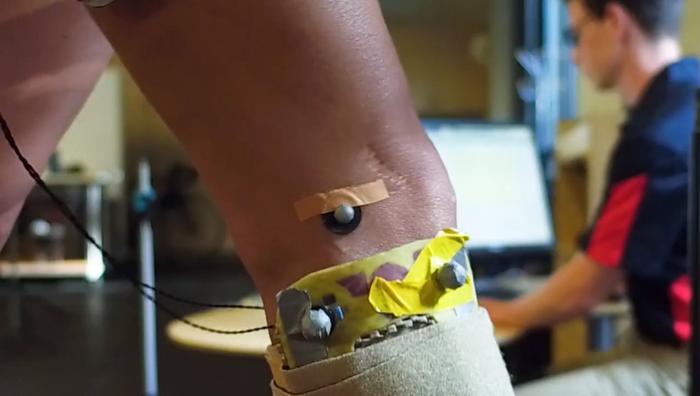
In their first two visits, participants received a baseline MRI and practiced walking on a pressure-sensitive treadmill while motion-capture cameras recorded the mechanics of their gait. This allowed the researchers to determine whether turning the patient’s toe inward or outward would reduce load more, and whether a 5° or 10° adjustment would be ideal.
This personalized analysis also screened out potential participants who could not benefit from the intervention, as none of the foot angle changes could decrease loading in their knees. These participants were included in previous studies, which may have contributed to those studies’ inconclusive pain results.
Moreover, after their initial intake sessions, half of the 68 participants were assigned to a sham treatment group to control for the placebo effect. These participants were prescribed foot angles that were actually identical to their natural gait. Conversely, participants in the intervention group were prescribed the change in foot angle that maximally reduced their knee loading.
Participants from both groups returned to the lab for six weekly training sessions, where they received biofeedback — vibrations from a device worn on the shin — that helped them maintain the prescribed foot angle while walking on the lab’s treadmill. After the six-week training period, participants were encouraged to practice their new gait for at least 20 minutes a day, to the point where it became natural. Periodic check-in visits showed that participants were adhering to their prescribed foot angle within a degree on average.
After a year, all participants self-reported their experience of knee pain and had a second MRI to quantitatively assess the damage to their knee cartilage.
“The reported decrease in pain over the placebo group was somewhere between what you’d expect from an over-the-counter medication, like ibuprofen, and a narcotic, like oxycontin,” Uhlrich said. “With the MRIs, we also saw slower degradation of a marker of cartilage health in the intervention group, which was quite exciting.”
Beyond the quantitative measures of effectiveness, participants in the study expressed enthusiasm for both the approach and the results. One participant said: “I don’t have to take a drug or wear a device…it’s just a part of my body now that will be with me for the rest of my days, so that I’m thrilled with.”
Participants’ ability to adhere to the intervention over long periods of time is one of its potential advantages.
“Especially for people in their 30’s, 40’s, or 50’s, osteoarthritis could mean decades of pain management before they’re recommended for a joint replacement,” Uhrlich said. “This intervention could help fill that large treatment gap.”
Before this intervention can be clinically deployed, the gait retraining process will need to be streamlined. The motion-capture technique used to make the original foot angle prescription is expensive and time-consuming; the researchers envision this intervention to eventually be prescribed in a physical therapy clinic and retraining can happen while people go for a walk around their neighborhood.
“We and others have developed technology that could be used to both personalize and deliver this intervention in a clinical setting using mobile sensors, like smartphone video and a ‘smart shoe’,” Uhlrich said. Future studies of this approach are needed before the intervention can be made widely available to the public.
Image: At the beginning of the study, participants received a baseline MRI and walked on a force-sensitive treadmill while motion-capture cameras recorded their walking mechanics.
View more Credit: Utah Movement Bioengineering Lab