Why pharmacists should manage repeat prescriptions
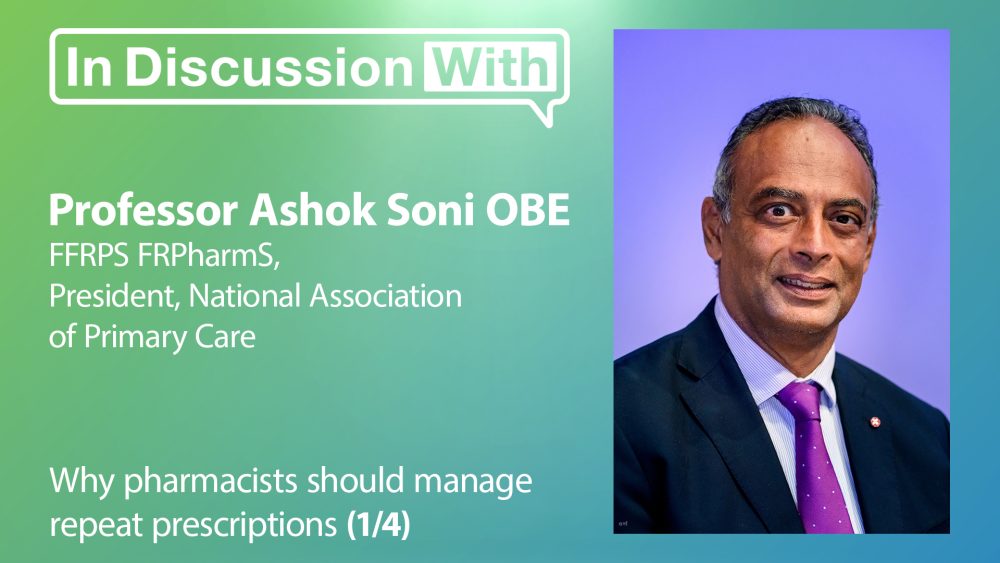
Professor Ashok Soni OBE is a community pharmacist and president of the National Association of Primary Care. He recently called on the Government to make better use of community pharmacists. IMI spoke to him to find out what steps would be needed for this to happen.
Professor Soni’s first recommendation is to allow community pharmacists to take on the management of repeat prescriptions for long-term conditions. GP colleagues have told him that the “repeat prescription process is quite laborious from their point of view”. Community pharmacists, who are experts at managing medicines and medicines’ optimisation, could monitor patients effectively and manage medicines for those with stable conditions by working within agreed protocols, he says. If the situation changed then they could be referred to their doctor or to a specialist pharmacist, as appropriate. Allowing community pharmacists to manage repeat prescribing in this way “would take a huge amount of workload off general practice and enable them to spend their time doing the things that they really are experts at doing”, he says.
Initially, it would not be necessary for all community pharmacist to be prescribers, although that is the ideal position, Professor Soni concedes. “Over the course of the next two to three years we’re going to see that happen anyway, and actually, by 2026, all pharmacists coming out of university will be prescribers. And, hopefully, the vast majority of pharmacists that are already working out in communities will have had the opportunity to train as prescribers”, he says.
One of the problems with the current repeat dispensing system is that after 6 -12 months the prescription effectively expires and patient is obliged to return to the GP to renew the prescription, even if their condition is stable. This particular workload could be avoided altogether using a pharmacy-based system. The pharmacist would be able to identify patients whose needs had changed and, with appropriate IT, communicate with the GP or nurse quickly and efficiently so that patients “go [to the GP] when they need to be seen rather than just because the system says it’s time”, he says.
It would, of course, be necessary to introduce a suitable system for payment for these services. This could be on fee-for-service (activity) basis or could be payment for a patient’s care for a period of time.
Professor Soni argues: “My purpose is to come up with the proposal about what we can do. It’s for others then to work out …. what’s the best way to pay for it. There are different ways to make that work ….. and I think we can. There’s no reason why you can’t find the resource to do that because if I’m releasing capacity from general practice, and that means that maybe some patients aren’t going into hospitals that currently are, because they’re better managed by the GP as well as by us, that’s going to save money at some point in the system and therefore that money is just being redistributed”.
About Ashok Soni OBE
Ashok Soni OBE is president of the National Association of Primary Care (NAPC) and is the first pharmacist to hold this position. As a community pharmacist and owner of three pharmacies, much of his time over the past two to three years has been devoted to vaccinations. Having “some incredibly talented staff” has enabled him to take on a number of other roles: He is a non-executive director at Oxford University Hospitals and a non-executive director at Sussex Integrated Care Systems (ICS), known as NHS Sussex, where he chairs the Workforce and Remuneration body.
Read and watch the full series on our website or on YouTube.
This episode of ‘In Discussion With’ is also on Spotify. Listen to the full podcast now.