Cartridges for 3D printing of medicines stable for six months
GERPAC Congress 2026 highlights
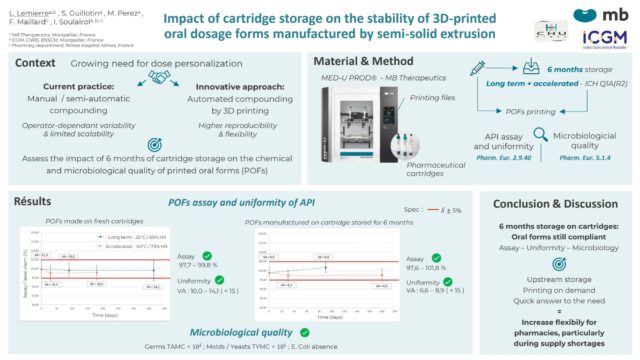
Pharmaceutical cartridges for 3D printing can be stored for six months and still produce printed oral doses that meet European Pharmacopoeia requirements, according to Léna Lemierre (MB Therapeutics and ICGM, Montpellier) and colleagues. The ability to store cartridges and print on demand, by means of semi-solid extrusion 3D printing, could give pharmacies considerable flexibility.
There is a growing need for personalised doses. Manual and semi-automated compounding suffer from operator-dependent variability and are difficult to scale up. Automated compounding by 3D printing offers greater reproducibility and flexibility. However, it requires semi-solid formulations that remain suitable for printing after storage.
In this study, five batches of a semi-solid formulation containing an active pharmaceutical ingredient – melatonin – were filled into cartridges. Printed oral dosage forms (POFs) were produced by semi-solid extrusion on a MED-U PROD® printer (MB Therapeutics). The team compared POFs made from freshly prepared cartridges with those made from cartridges stored for six months under long-term conditions before printing. Stability studies followed ICH Q1A(R2), under long-term (25°C) and accelerated (40°C/75% relative humidity) conditions. Drug content and content uniformity were assessed according to the European Pharmacopoeia (2.9.40), with an acceptance value of 15 or below considered compliant. Microbiological quality was tested according to the European Pharmacopoeia (5.1.4).
POFs made from fresh cartridges remained compliant throughout the study, which covered up to 12 months under long-term conditions and 6 months under accelerated conditions. Mean drug content was 97.7–99.8% of the label claim, and acceptance values ranged from 10.0 to 14.1. POFs made from cartridges stored for six months performed at least as well. Mean drug content was 97.6–101.8%, and acceptance values were 6.6–8.9, well below the limit. There was no evidence of degradation or increased variability. Microbiological quality was compliant in all samples: total aerobic microbial and yeast/mould counts were below the limits, and Escherichia coli was not detected.
The authors concluded that cartridges stored for six months produced POFs of comparable quality to those from freshly prepared cartridges. This supports a strategy of storing cartridges upstream and printing on demand to respond quickly to patients’ needs. The study of POFs from stored cartridges is ongoing.
Lemierre L, Guillotin S, Perez M et al. Impact of cartridge storage on the stability of 3D-printed oral dosage forms manufactured by semi-solid extrusion. Poster. GERPAC Congress 2026
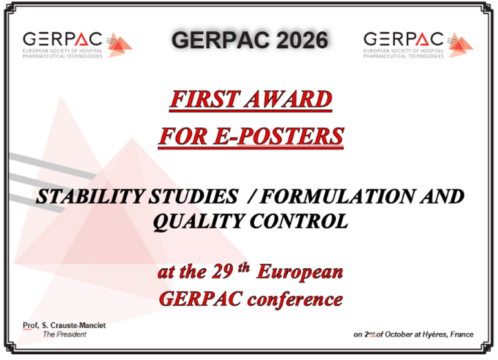
This e-poster was awarded first prize in the Stability Studies/Formulation and Quality Control category.
Click to enlarge